Ranking in Google’s top 10 used to be the single clearest proxy for visibility. That assumption is breaking down fast. Research from Ahrefs shows the overlap between AI-cited sources and Google’s top-10 results fell from roughly 76% in July 2025 to approximately 38% by February 2026 — and BrightEdge, using a different measurement methodology, put the figure closer to 17%. In plain terms: the majority of AI citations now come from pages that do not rank in the top 10 for the same query. If your strategy still treats rank as the destination, you are optimising for a signal that generative engines increasingly ignore.
The real overlap figures — and why you should read them carefully
Before drawing strategy conclusions, it is worth being precise about what the data actually says — and what it does not.
Ahrefs tracked the share of AI Overview citations that also appeared in Google’s organic top 10 for the same query. In July 2025, that overlap stood at around 76%. By February 2026, it had fallen to approximately 38%. That is a roughly 50% relative decline in under eight months — a meaningful directional shift by any standard.
BrightEdge reported a lower figure still, around 17%, using a different sample of queries and a different detection methodology. The gap between the two figures does not mean one is wrong. It reflects genuine methodological differences: query set composition, industry mix, how “citation” is defined, and how consistently AI Overviews appear in the first place.
The honest caveat matters here. Some of the apparent decline in overlap is an artefact of better measurement: as tools for detecting AI citations improved, researchers began capturing sources they had previously missed — sources that were always outside the top 10 but went unrecorded. That does not make the trend any less real or strategically significant, but it does mean you should resist treating the specific percentages as precise engineering tolerances. The direction is clear; the exact magnitude is still being calibrated by the industry.
| Source | Date / Period | Overlap with top 10 | Notes |
|---|---|---|---|
| Ahrefs | July 2025 | ~76% | AI Overviews citations vs. organic top 10 |
| Ahrefs | February 2026 | ~38% | Same methodology; same query set |
| BrightEdge | 2025–2026 | ~17% | Different query sample and detection method |
Why the gap exists: the mechanics behind AI source selection
Understanding why AI citations diverge from top-10 rankings requires understanding how generative engines actually construct answers — which is fundamentally different from how a ranking algorithm works.
Query fan-out: one question, many sub-queries
When a user submits a query to an AI-powered search engine, the system does not simply retrieve the top-ranked page for that exact phrase. It decomposes the original question into a set of sub-queries — sometimes dozens — each targeting a specific facet of the answer. A question about choosing a project management tool might fan out into sub-queries about pricing models, integration capabilities, team size fit, and migration complexity. Each sub-query retrieves its own set of sources.
The result is that a page ranking well for the original query may never appear in the citation set, while a page ranking well for one narrow sub-query — but nowhere near the top 10 for the original term — gets cited prominently. This is the core structural reason why AI vs search engine rankings diverge: the engine is answering a different set of questions than the one the user typed.
Answer-fit over rank: what AI engines actually optimise for
Traditional search ranking rewards a combination of relevance, authority, and user engagement signals. Generative engines layer an additional filter on top: does this source contain a passage that directly and extractably answers the sub-query? A page with a clear, self-contained answer to a narrow question will often beat a higher-authority page whose answer is buried in narrative prose or requires the reader to synthesise across multiple sections.
This is why answer-first content structure is not just a readability best practice — it is a citation signal. Pages that lead with the answer, support it with verifiable claims, and organise information in discrete, extractable units are structurally better candidates for AI citation, regardless of their organic rank.
The rise of YouTube and community sources
A significant share of AI citations now come from sources that traditional SEO has historically treated as secondary: YouTube videos, Reddit threads, Quora answers, specialised forums, and community-driven platforms. These sources are trusted by generative engines for a specific reason — they contain first-person, experience-based answers that are difficult to find in polished editorial content.
For agencies, this has a direct implication: a brand’s YouTube channel, its presence in relevant subreddits, and its participation in community discussions are no longer just brand-building activities. They are potential citation surfaces. Ignoring them means ceding ground to competitors who are present in those formats.
The vertical dimension: overlap varies enormously by industry
One of the most practically important findings in the available research is that the AI citation gap is not uniform across industries. The shift is large in some verticals and nearly absent in others — which means the strategic implications for your team depend heavily on which sector you operate in.
In e-commerce, the overlap between AI citations and top-10 rankings remains relatively high. Product pages, pricing information, and transactional content tend to come from the same authoritative sources that rank well organically. The disruption is modest.
In education, health, legal, and other YMYL (Your Money or Your Life) categories, the divergence is significantly larger. These are precisely the areas where AI engines invest most heavily in sourcing from diverse, authoritative references — academic institutions, government bodies, specialist publications — many of which do not optimise for traditional SEO and therefore do not rank in the top 10 for competitive queries.
The practical takeaway is that you should not assume the aggregate figures apply to your specific situation. A content lead at a B2B SaaS agency faces a different landscape than one at a healthcare publisher. The data gives you a direction; your own vertical audit gives you the actual answer.
What this means for how you measure visibility
If AI citations increasingly come from outside the top 10, then organic rank alone is an incomplete proxy for visibility. This is not an argument to abandon rank tracking — it remains a strong and meaningful signal, and there is still clear correlation between ranking well and being cited by AI engines. But it is an argument to stop treating rank as sufficient.
Agencies that report only on rankings and organic traffic are now reporting on a partial picture. A client can be losing ground in AI citation — the channel that is growing fastest in terms of user interaction — while their rank report looks stable. That is a reporting gap with real business consequences.
The practical response is to add AI citation tracking as a distinct metric in your reporting stack. Tools for this are still maturing, but the methodology is straightforward: sample your target queries regularly across the major AI-powered surfaces (Google AI Overviews, ChatGPT Search, Perplexity, Bing Copilot), record which sources are cited, and track whether your content appears. Over time, this gives you a citation share metric that is independent of rank — and increasingly predictive of the visibility that matters to users.
How to optimise content for AI citation
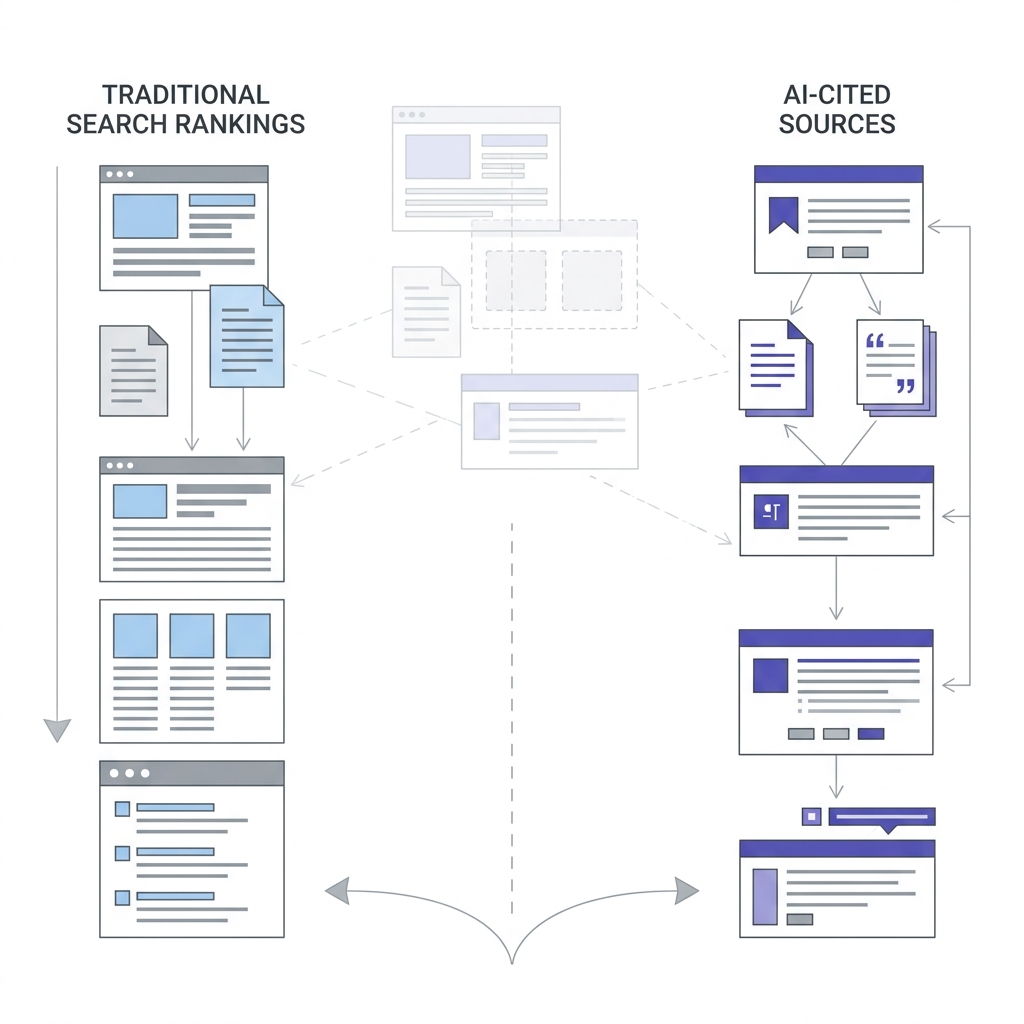
Optimising for AI citation is not a replacement for SEO — it is an extension of it. Most of the practices that make content citable by AI engines also make it more useful to human readers and more competitive in organic search. The difference is emphasis and structure.
Answer-first structure and extractable claims
AI engines extract passages, not pages. A piece of content that buries its core answer in paragraph six, after three paragraphs of context-setting, is a poor candidate for citation even if it ranks well. Restructure your content so that the direct answer to the primary question appears in the first paragraph — ideally the first sentence. Each subsequent section should be similarly self-contained: a reader (or an AI) should be able to extract any H2 section and understand its point without reading the rest of the article.
Verifiable, autonomous claims matter too. A sentence like “studies show that X improves Y” is not extractable — it requires the reader to chase down the study. A sentence like “According to [Source], X improved Y by Z in [context]” is extractable, attributable, and trustworthy. That is the unit of content that AI engines cite.
Multi-format presence
Given the growing share of AI citations coming from video and community sources, a single-format content strategy is a structural disadvantage. The same core information — a guide, a how-to, an analysis — should exist in at least two formats: a written article optimised for search, and a video or community contribution optimised for the platforms where AI engines increasingly source their answers.
This does not require doubling your content production budget. It requires thinking about format as a distribution decision, not an afterthought. A well-structured article can be repurposed into a YouTube explainer; a forum answer can be expanded into a full piece. The goal is presence across the surfaces that AI engines crawl and cite.
Sourced data and named attribution
AI engines show a measurable preference for content that cites its sources explicitly. Pages that reference named studies, named organisations, and named data points are more likely to be cited than pages that make equivalent claims without attribution. This aligns with the anti-hallucination priorities built into most generative AI systems: a cited claim is easier to verify and therefore safer to surface to users.
For content teams, this means developing a house standard for attribution: every statistical claim names its source, every quote names its speaker, every data point links to its origin. This is good journalism practice — and it is now also a citation optimisation practice.
Don’t abandon SEO — but stop treating it as sufficient
The data on AI citation overlap is sometimes used to argue that SEO is dying. That argument is not supported by the evidence. Ranking well in organic search remains a strong positive signal for AI citation — even at 38% overlap, top-10 pages are still cited at a rate far above their share of the total web. Authority, backlinks, and technical SEO continue to matter because they are proxies for trustworthiness, and trustworthiness is a core criterion for AI source selection.
The correct reading of the data is not “SEO is irrelevant” but “SEO is necessary but no longer sufficient.” A page that ranks well and is structured for citation will outperform a page that only does one of those things. The agencies that will win in this environment are those that treat GEO (Generative Engine Optimisation) as a complement to SEO, not a competitor to it — allocating effort to both rank signals and citation signals simultaneously.
The agency checklist: from rank-first to citation-ready
The following checklist summarises the practical adjustments for content and SEO leads who want to move from a rank-first to a citation-ready strategy. It is not a replacement for a full GEO audit — it is a starting point for identifying where the biggest gaps are likely to be.
- Audit your vertical: Sample 20–30 target queries across AI-powered surfaces and record which sources are cited. Establish your baseline overlap rate before assuming the aggregate figures apply to you.
- Add AI citation tracking to your reporting: Track citation share as a distinct metric, separate from rank and organic traffic. Even a manual monthly sample is more informative than no tracking at all.
- Restructure for extractability: Audit your top-performing pages. Does each section lead with its conclusion? Can any H2 block be read in isolation and still make sense? If not, restructure.
- Tighten attribution standards: Every statistical claim should name its source. Every data point should link to its origin. Make this a house style rule, not an editorial preference.
- Expand to multi-format: Identify your five highest-value content pieces and plan a video or community version of each. Prioritise formats where your target audience already spends time.
- Map your community presence: Identify the forums, subreddits, and Q&A platforms where your target queries surface. Establish a presence there with substantive, attributable contributions — not promotional content.
- Keep investing in SEO fundamentals: Authority, technical health, and backlinks remain positive signals for AI citation. Do not redirect that budget — extend it.
How SEO Optimizer fits into a citation-ready workflow
SEO Optimizer is built for content teams that need to produce at scale without sacrificing the editorial quality that citation requires. Its two-pass generation with anti-hallucination verification is designed specifically to produce the kind of content described in this article: answer-first structure, sourced claims, named attribution, and extractable sections — the properties that make content citable by generative engines, not just rankable by traditional ones.
For agencies managing content production across multiple clients and verticals, the platform’s per-credit cost model makes it practical to apply GEO-optimised content standards at volume — without the manual overhead of restructuring every article by hand. If you are rethinking how you allocate content effort between rank signals and citation signals, that is the workflow problem SEO Optimizer is designed to solve.
For more on the strategic framework behind these ideas, see our pieces on GEO vs SEO, query fan-out explained, and measuring AI visibility.
Frequently asked questions
Does ranking in Google’s top 10 still help with AI citation?
Yes — but it no longer guarantees it. Top-10 pages are still cited at a disproportionately high rate compared to their share of the total web. However, as the Ahrefs and BrightEdge data shows, the majority of AI citations now come from outside the top 10. Rank is a positive signal, not a sufficient one.
Why do different studies report such different overlap figures?
The gap between Ahrefs (~38%) and BrightEdge (~17%) reflects genuine methodological differences: different query sets, different industry mixes, different definitions of what counts as a citation, and different detection tools. Neither figure is wrong — they are measuring slightly different things. The directional trend (overlap is declining) is consistent across both.
Is the drop in overlap entirely due to AI engines changing behaviour?
No. Part of the observed decline reflects improvements in citation-detection methodology — researchers can now identify more AI-cited sources that were previously missed. The drop is real and strategically significant, but not all of it is Google or other AI engines changing how they select sources. Treat the figures as directional, not as precise measurements.
Which industries are most affected by the AI citation gap?
The divergence between AI citations and top-10 rankings is largest in education, health, legal, and other YMYL categories. It is relatively modest in e-commerce, where transactional content tends to come from the same authoritative sources that rank well organically. Check your own vertical before assuming the aggregate figures apply to your situation.
What is the single most impactful change a content team can make?
Restructure for extractability. Ensure that every section of every article leads with its direct answer, that every statistical claim names its source, and that any H2 block can be understood in isolation. This is the structural property that AI engines optimise for when selecting citations — and it also improves readability for human users.
Leave a Reply